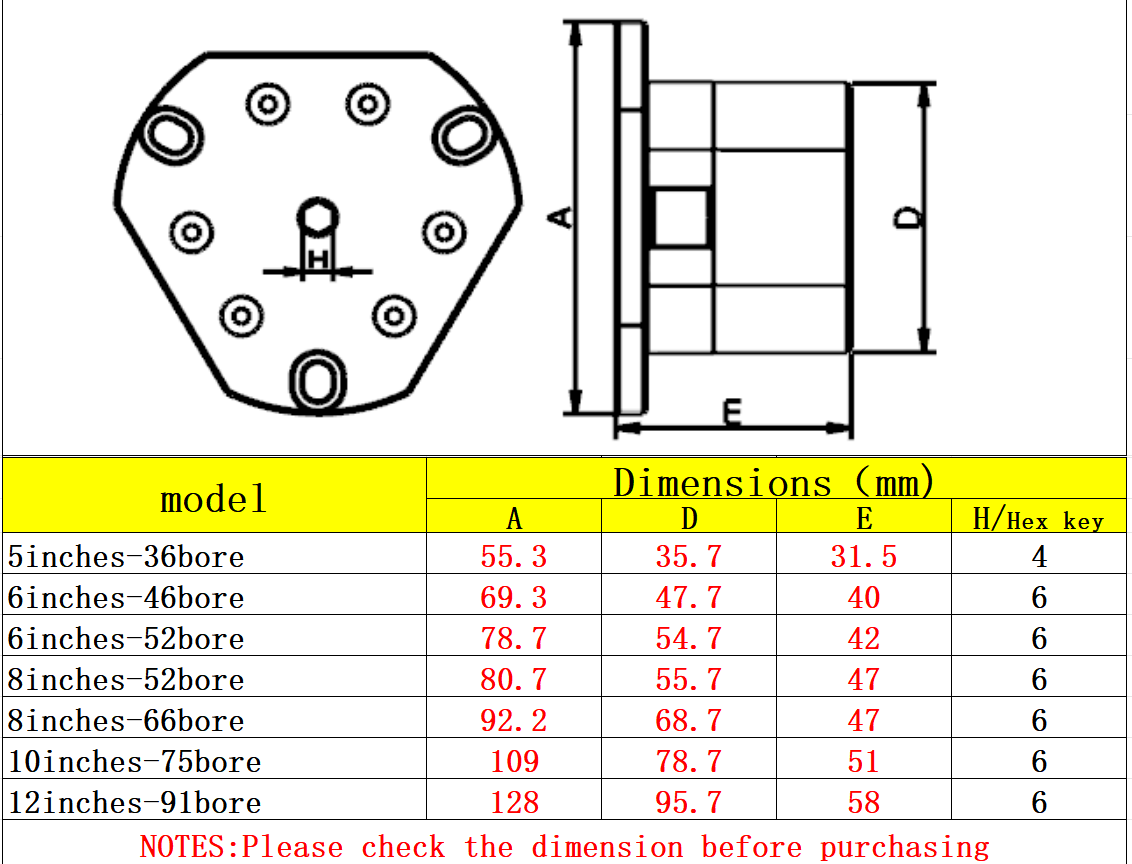
Tailstock,it is an indispensable partner in achieving precision, stability, and versatility. By providing critical support, ensuring alignment, and enabling essential axial machining operations, it expands the capabilities of the cnc lathe significantly.
Tailstocks are primarily classified based on how the quill is actuated, which directly impacts automation level, force, and precision:
1.Manual Tailstocks:
Operation: Quill extended/retracted via a handwheel and leadscrew. Position and force are set entirely by the operator.
Advantages:Simple, robust, lowest cost. Reliable for low-volume or maintenance work.
Disadvantages:Slowest, requires operator intervention for every movement, limits automation potential. Force application is subjective and inconsistent. Not suitable for high-volume production or complex, unattended cycles.
Best For:Prototyping, toolrooms, repair shops, low-volume job shops, educational settings.
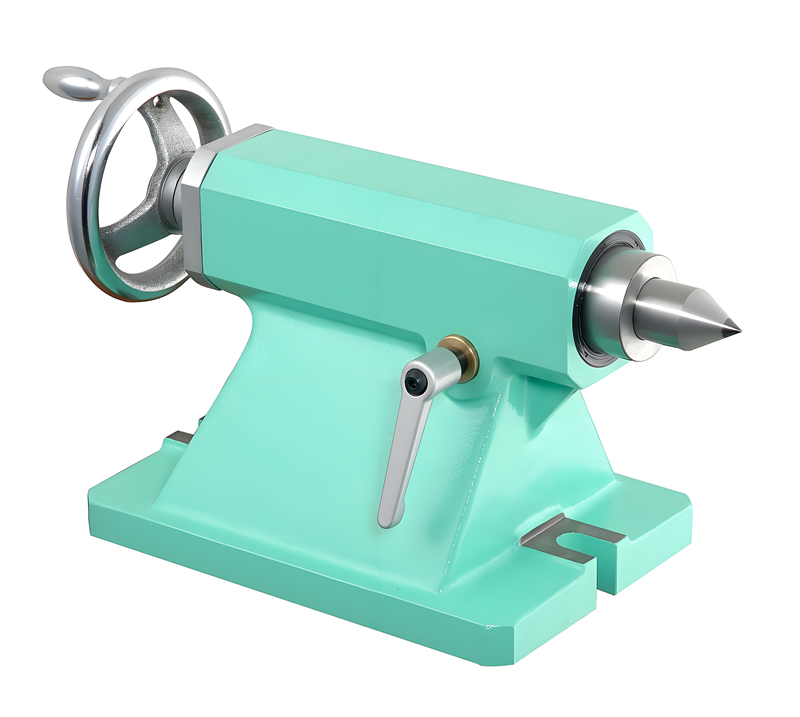
2.Pneumatic Tailstocks:
Operation:Compressed air drives a piston to extend the quill. Retraction is usually spring-loaded. Actuation is controlled by solenoid valves via CNC program commands (M-codes).
Advantages:Faster than manual, enables automation. Good for applications needing rapid engagement/disengagement with moderate force (e.g., light support, quick center changes). Relatively simple and cost-effective for automation.
Disadvantages:Force is limited by air pressure and cylinder size, can be inconsistent. Not ideal for high-force applications like heavy drilling or supporting very large workpieces. Spring retraction can be less positive than powered retraction. Requires a compressed air supply.
Best For:High-volume production of small-sized parts requiring consistent support but not extreme force; automated drilling/center operations where speed is key.
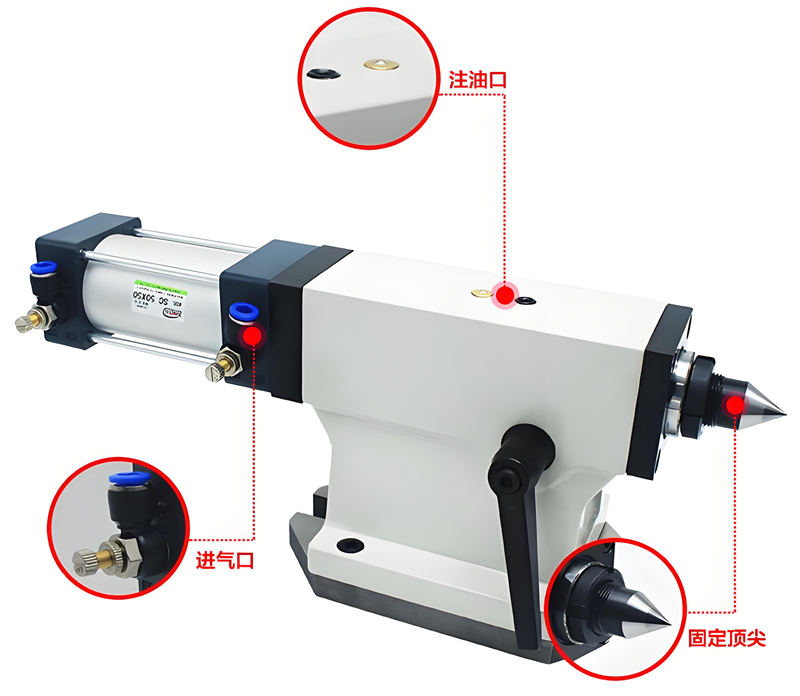
3. Hydraulic Tailstocks:
Operation: Hydraulic fluid under pressure drives a piston to extend the quill. Hydraulic pressure also typically powers retraction. Controlled by CNC program commands (M-codes) via hydraulic valves.
Advantages:Capable of generating very high, consistent forces – ideal for supporting large/heavy workpieces and demanding operations like large diameter drilling or deep hole boring. Smooth actuation. Positive extension and retraction.
Disadvantages:More complex and expensive than pneumatic. Requires a hydraulic power unit (pump, reservoir, valves). Potential for leaks. Slower than pneumatic due to fluid dynamics.
Best For: Heavy machining, large-part turning, applications requiring high thrust force (drilling large holes), supporting very long or heavy workpieces.

4.Servo-Driven Tailstocks:
Operation: An integrated servo motor drives a ball screw to position the quill. Fully programmable via the CNC control. Position, speed, and force (torque) are precisely controlled and monitored.
Advantages: Highest precision positioning. Programmable force control – the CNC can apply a specific, consistent pressure and monitor it in real-time (enabling overload protection). Fast and precise. Enables complex, synchronized movements within the machining cycle. Ideal for unattended operation and lights-out manufacturing.
Disadvantages:Most complex and expensive type. Requires sophisticated CNC integration.
Best For: High-precision machining, complex unattended production cycles, applications requiring precise force control (e.g., supporting delicate parts), integration into advanced manufacturing cells, high-value part production.

The tailstock's primary function is deceptively simple yet criticallyimportant:
1. Workpiece Support & Stability: This is its fundamental role. When machining long, slender shafts or bars (where length significantly exceeds diameter), the unsupported end tends to deflect (bend) under the cutting forces exerted by the tool. This deflection causes vibration, chatter, dimensional inaccuracy, poor surface finish, and can even lead to tool breakage or scrapped parts. The tailstock provides a rigid, adjustable support point at the opposite end of the workpiece from the spindle chuck, counteracting these forces and ensuring the workpiece remains stable and true throughout the machining process.
2.Axial Alignment: It helps maintain the workpiece's centerline alignment with the lathe's spindle axis. Proper alignment is crucial for achieving concentricity (roundness) and accurate dimensions along the entire length of the part.
3.Enabling Secondary Operations: The tailstock isn't limited to passive support. It can actively hold tools for operations performed *along* the workpiece axis, such as:
Drilling: Mounting drill bits directly in the tailstock quill to create center holes or through-holes.
Reaming: Finishing pre-drilled holes to precise size and smoothness.
Tapping: Creating internal threads using a tap held in the tailstock.
Center Drilling: Creating precise conical seats at the end of a workpiece to accept a live center (a rotating point) for initial setup and support.
4.Holding Workpieces:In some configurations, specialized chucks or fixtures can be mounted directly onto the tailstock spindle to hold the end of a workpiece, particularly useful for short parts or specific setups.
Understanding its structure clarifies its function:
1.Base: Mounts onto the lathe bed ways, providing the foundation and allowing the entire tailstock to slide along the bed to accommodate different workpiece lengths. Locking mechanisms secure it firmly in position.
2. Body/Housing:The main casting that houses the internal mechanisms.
3. Quill (Spindle):The hollow, precision-ground cylindrical shaft that extends and retracts from the body. This is where the tool (drill, reamer, tap) or the workpiece support (dead center, live center, chuck) is mounted. The quill bore is typically Morse Taper sized to accept standard tooling shanks or centers.
4.Quill Drive Mechanism:This varies by tailstock type:
Manual:Uses a handwheel connected to a leadscrew to advance/retract the quill.
Pneumatic/Hydraulic:Uses air or hydraulic pressure to actuate a piston, moving the quill with significant force. Often controlled by the CNC program (M-codes).
Servo-Driven:Uses an integrated servo motor and ball screw for precise, programmable positioning and force control, fully integrated with the CNC system.
5. Quill Lock: A mechanism (often a lever or clamp) to rigidly lock the quill in position after extension, preventing any movement during cutting.
6. Tailstock Lock: Secures the entire tailstock body firmly to the lathe bed once positioned. Crucial for preventing shifting under load.
7.(Optional) Live Center:A rotating point mounted in the quill. Its bearings allow it to spin with the workpiece, minimizing friction and heat buildup compared to a static "dead center." Essential for supporting rotating work at high speeds.
8.(Optional) Force Monitoring/Overload Protection:Advanced tailstocks, especially servo-driven or some hydraulic types, may include sensors to monitor the force exerted by the quill and trigger an alarm or retract if excessive force is detected (e.g., if the workpiece bends or the tool jams), protecting the machine and workpiece.
Selecting a tailstock involves balancing several factors:
Workpiece Characteristics:Length, diameter, weight, material (affects cutting forces).
Required Operations:Primarily support? Heavy drilling? Tapping? Need for precise force control?
Production Volume & Automation Needs:High-volume automated lines demand servo or robust pneumatic/hydraulic. Low volume might suffice with manual.
Required Force & Rigidity:Heavy cuts or large workpieces need hydraulic or high-force servo.
Precision Requirements:High-precision applications benefit significantly from servo control.
Budget: Manual is cheapest; servo is a significant investment but offers the most capability and automation ROI for high-volume/precision work.