Milling is a fundamental machining process used to remove material from a workpiece, producing complex shapes and surfaces. Two primary techniques dominate this field: climb milling (down milling) and conventional milling (up milling). While both methods achieve similar end goals, their mechanics, advantages, and limitations differ significantly. This article explores the principles, applications, and key considerations for selecting between climb and conventional milling.
Climb Milling (down milling)
Definition and Mechanism
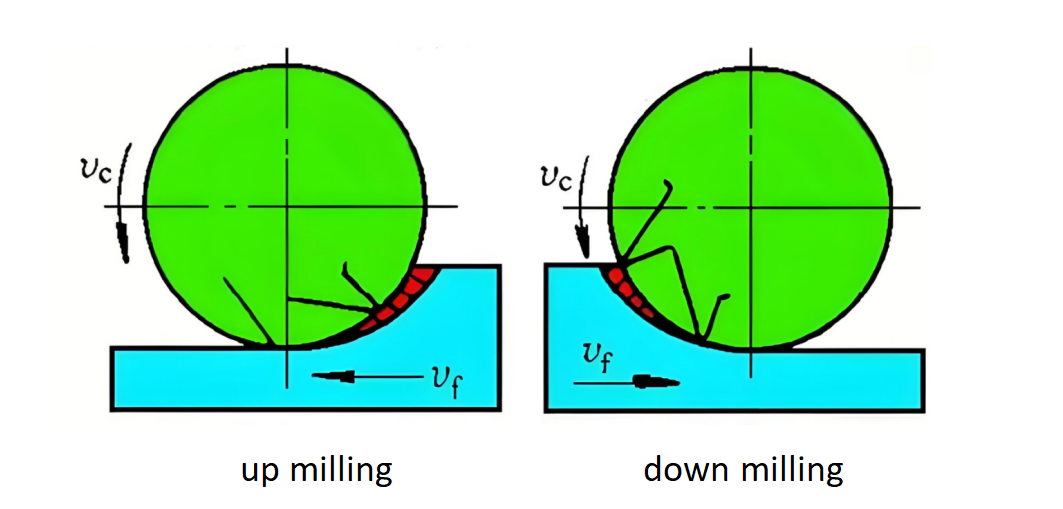
In climb milling, the cutting tool rotates in the same direction as the workpiece feed. The teeth of the cutter engage the material at a maximum thickness and exit near zero thickness, resulting in a gradual reduction in cutting forces.
Advantages:
1. Surface Finish: Reduced tool deflection and minimal burr formation yield superior surface quality.
2. Tool Life: Consistent chip thickness and efficient heat dissipation prolong cutter longevity.
3. Energy Efficiency: Lower power consumption due to reduced cutting forces.
4. Workpiece Stability: Downward cutting forces press the workpiece against the table, minimizing vibration.
Disadvantages:
1. Machine Requirements: Requires backlash-free machinery to avoid sudden tool engagement.
2. Material Limitations: Unsuitable for hard or abrasive materials, as rapid tool wear may occur.
3. Safety Risks: High cutting forces can pull the workpiece upward if not securely clamped.
Conventional Milling(up milling)
Definition and Mechanism
In conventional milling, the cutter rotates opposite to the workpiece feed. The tool begins cutting with zero chip thickness, gradually increasing to a maximum before disengaging.
Advantages:
1. Machinery Compatibility: Suitable for older machines with inherent backlash, as cutting forces push the workpiece away from the cutter.
2. Versatility: Effective for machining hard or uneven surfaces, such as castings with scale.
3.Process Stability: Gradual engagement reduces shock loads, ideal for fragile tools or thin-walled workpieces.
Disadvantages :
1. Surface Quality: Higher friction and upward cutting forces often result in poorer surface finishes.
2. Tool Wear: Increased heat generation and uneven chip formation accelerate cutter degradation.
3. Power Consumption: Higher energy demand due to greater resistance during cutting.
Key Comparisons:
Factor | Down milling | Upmilling |
Cutting Force Direction | Downward,stabilizing workpiece | Upward, lifting workpiece |
Surface Finish | Superior | Moderate |
Tool Life | Longer | Shorter |
Machine Requirements | Backlash-free equipment | Compatible with older machines |
Material Suitability | Soft metals, plastics | Hard or uneven surfaces |
Applications:
Down milling: Preferred for finishing operations, CNC machining, and materials like aluminum or composites.
Upmilling: Ideal for roughing, heavy stock removal, or machining hardened steels and castings.
Selection Criteria:
1. Material Properties: Soft materials favor climb milling; hardened or uneven surfaces suit conventional milling.
2. Machine Capability: Modern CNC machines with ball screws optimize climb milling, while manual mills often default to conventional.
3. Stage of Machining: Use conventional milling for roughing and climb milling for finishing.
4. Workpiece Fixation: Secure clamping is critical for climb milling to counteract upward forces.
Conclusion
The choice between climb and conventional milling hinges on material properties, machine capabilities, and desired outcomes. Climb milling excels in precision and efficiency for modern setups, while conventional milling remains indispensable for challenging materials or legacy equipment. By understanding their distinct mechanics, machinists can optimize performance, tool life, and surface quality in diverse applications.
This article provides a foundational guide for engineers, CNC operators, and manufacturing enthusiasts to strategically leverage these milling techniques.