Compared with the flat-bed CNC lathe, the slant-bed CNC lathe has many advantages.
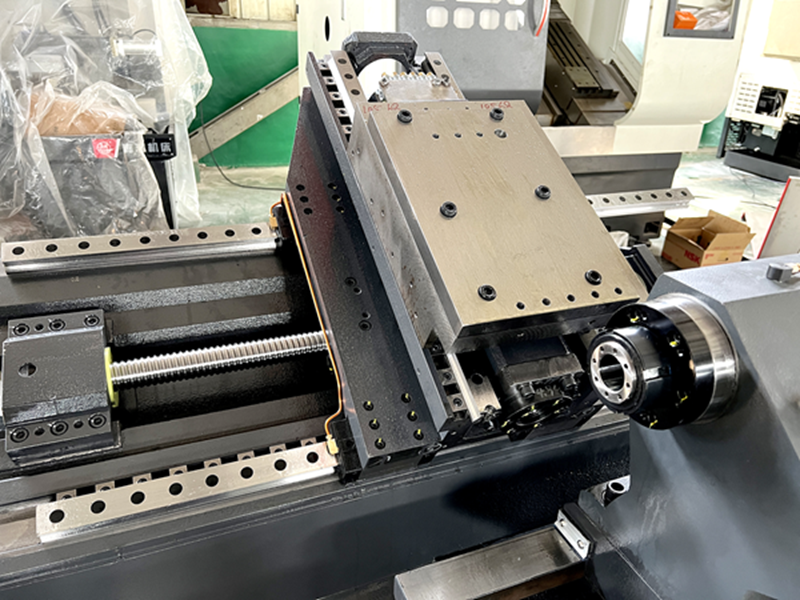
1.Cutting rigidity: The cross-sectional area of the inclined bed is larger than that of the flat bed of the same specification, which makes it more resistant to bending and twisting. The cutting tool of the slant-bed CNC lathe cuts downward from the inclined top of the workpiece. The cutting force is basically consistent with the direction of the workpiece's gravity, so the spindle operates more smoothly and is less likely to cause cutting vibration. When a flat-bed CNC lathe is in operation, the cutting force between the tool and the workpiece is at a 90° Angle to the weight of the workpiece, which can easily cause vibration.
2.Machining accuracy: The layout of the slant-bed CNC lathe directly affects the clearance of the X-direction ball screw. Gravity directly acts on the axial direction of the screw, making the reverse clearance during transmission almost zero. However, the X-direction linear rods of the flat-bed CNC lathe are not affected by axial gravity, and the clearance cannot be directly eliminated. This is the inherent precision advantage of the slant-bed CNC lathe.
3.Production efficiency: The slant-bed CNC lathe has a stronger load-bearing capacity, can handle larger workpieces, and has a faster processing speed, which can significantly improve production efficiency. In addition, the automatic feeding system of the slant-bed CNC lathe is more outstanding. It can achieve automatic tool positioning and automatic tool changing during the processing, saving a large amount of labor and further improving production efficiency.
4.Processing range: The slant-bed CNC lathe has a more abundant tool library and can apply a variety of different tools, making it more adaptable. Meanwhile, the slant-bed CNC lathe has a stronger processing capacity and can handle workpieces of different materials and shapes, not being restricted by traditional machine tools.
Overall, slant-bed CNC lathes have significant advantages in terms of cutting rigidity, processing accuracy, production efficiency and processing range. However, the choice of which type of CNC lathe to use still needs to be determined based on specific processing requirements and production environments.