The high efficiency and precision of the gang tool lathe are inseparable from the "commanding" cnc program behind it. Programming serves as a bridge connecting design drawings with actual processing, directly determining the processing accuracy of parts, production efficiency, and the safe operation of equipment. Mastering the programming skills of gang-tooling lathe is the key to fully leveraging their advantages of being "quick" and "versatile".
I. Core Features of Programming for CNC Tool Placement Machines
Compared with traditional lathe or turret lathe machine, the programming of gang tool lathe has its unique features:
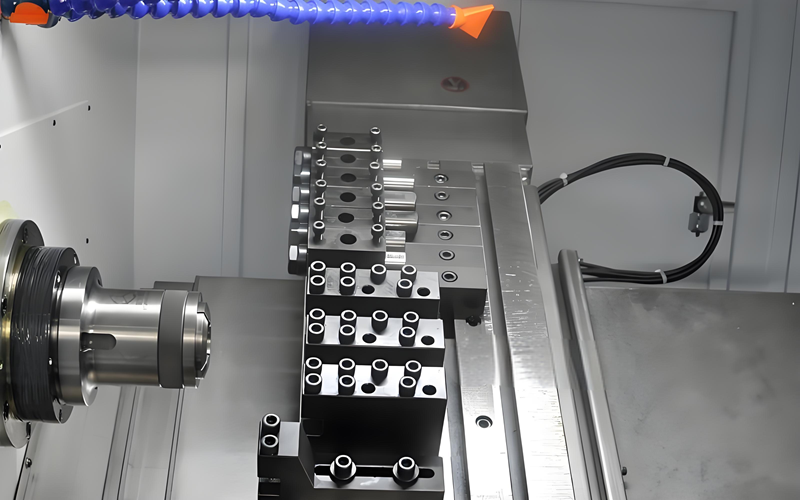
1. Tool management is fundamental: The tools are arranged along the X-axis or Z-axis. When programming, it is necessary to clearly define the position (tool number) of each tool on the tool rest and its tool compensation parameters (length compensation, radius compensation). Reasonable tool arrangement can reduce idle travel and further enhance efficiency.
2. Flexible application of G-code and M-code: Programming is mainly based on ISO standard G-code (motion instructions) and M-code (auxiliary function instructions). For instance, G00 is used for rapid positioning, G01 for linear interpolation, G02/G03 for circular interpolation, while M03/M05 controls the start and stop of the spindle.
3. Emphasize the optimization of cyclic instructions: The gang tool lathe is being machined small-sized shaft parts more. Extensive use of turning cyclic instructions in programming (such as G71 rough turning cycle, G70 finish turning cycle, G73 profiling cycle) can significantly simplify the program, reduce the amount of code, and ensure the consistency of processing at the same time.
4. Tool tip arc radius compensation is crucial: Due to the high processing accuracy requirements of the tool block machine, it is necessary to correctly set and invoke the tool tip arc radius compensation (G41/G42) to avoid processing dimensional errors caused by the tool tip arc, especially when precisely turning conical surfaces and arcs.
Ii. Basic Process of Programming
A qualified numerical control program usually follows the following steps:
1. Process Analysis and Planning
Analyze the part drawings to clarify requirements such as dimensional accuracy and surface roughness.
- Determine the processing route (such as rough turning of the outer circle first, then fine turning, and finally slotting, chamfering and threading).
Select the appropriate cutting tools and cutting parameters (rotational speed, feed rate, depth of cut).
2. Mathematical Processing:
Based on the geometric shape of the part, calculate the coordinate points required for programming (such as the center coordinates of the arc, the starting point and the ending point coordinates).
For complex curves, it may be necessary to use CAD/CAM software for automatic calculation.
3. Program writing
Convert the processing steps into G-codes and M-codes in accordance with the format of the numerical control system (such as FANUC, Siemens, etc.).
The beginning of a program usually includes the program number (Oxxxx), safety return to zero (G50 S2000 or G91 G28 U0 W0), and tool compensation call.
The program end must include a program termination instruction (M30 or M02).
4. Program Verification and Simulation
Conduct graphic simulation in the machine tool or programming software to check if the tool path is correct and if there is any risk of tool collision.
When processing for the first time, it is recommended to use the "single-segment" and "idle run" modes to gradually verify the accuracy of the program.
Iii. Common Programming Skills and Precautions
1. Optimize tool paths
Arrange the sequence of cutting tools reasonably to reduce their reciprocating movement during the processing.
When using the G00 for rapid positioning, be careful to avoid collisions between the tool and the workpiece, chuck, etc.
2. Skillful Use of subroutines
For recurring processing features (such as multiple identical slots or chamfers), subroutines (called by M98 and returned by M99) can be written to make the main program more concise and easier to modify.
3. Pay attention to the matching of cutting parameters
Select the appropriate rotational speed (S) and feed rate (F) based on the material properties (such as steel, aluminum, copper) and tool type (high-speed steel, cemented carbide).
During rough machining, a larger depth of cut can be adopted to enhance efficiency. However, during finish machining, the depth of cut should be reduced and the rotational speed increased to ensure surface quality.
4. Ensure dimensional accuracy
Regularly check and correct the tool compensation value, especially after long-term processing, as tool wear can affect dimensional accuracy.
For extremely demanding dimensions, a cyclical approach of "trial cutting - measurement - compensation" can be adopted to gradually approach.
5. Safety First
When programming, the travel limit of the machine tool must be taken into account to avoid over-travel alarms.
The setting of the spindle speed and feed rate must not exceed the rated capacity of the machine tool.
It is best to add G99 (feed rate set in millimeters per revolution) or G98 (feed rate set in millimeters per minute) at the beginning of the program to clearly define the feed mode.