With the continuous development of CNC technology, the motorized spindle (also known as an electric spindle) has become a core component in modern CNC lathe machines. Compared with traditional mechanical spindles, motorized spindles offer significant advantages in speed, precision, and integration. This article introduces what a motorized spindle is, compares it with a mechanical spindle, and explores its application in CNC lathes.
What is a Motorized Spindle?
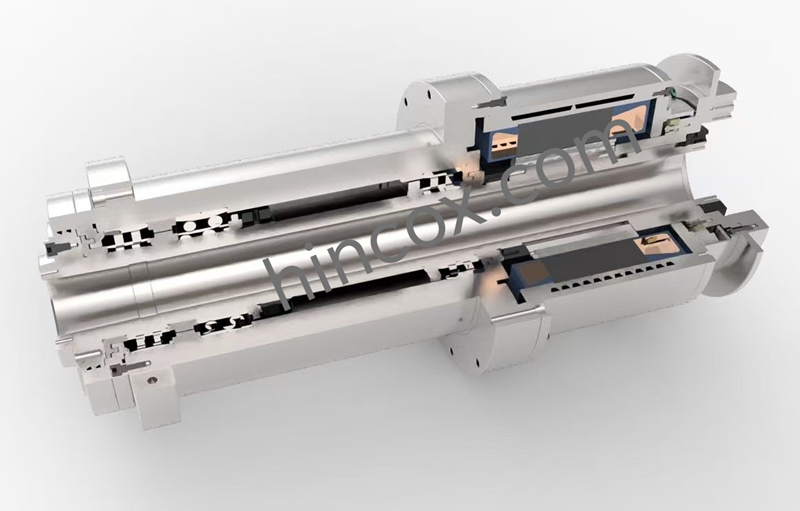
A motorized spindle is a spindle unit in which the motor is built directly into the spindle body. Instead of being powered by an external belt-driven or gear-driven system, the spindle is driven directly by an integrated motor. It combines the spindle, motor, cooling system, bearings, and sometimes even the encoder and tool clamping mechanism into a single compact unit.
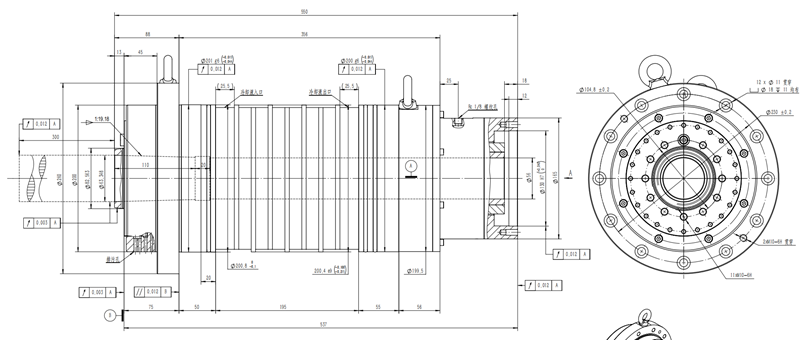
Main Features:
• High-speed operation (often >10,000 RPM)
• Compact and integrated structure
• High precision and low vibration
• Requires an external frequency converter or drive for speed control
• Often water- or oil-cooled for thermal stability
3. Mechanical Spindle: A Quick Overview
A mechanical spindle refers to a traditional spindle system that is driven by an external motor through belts or gears. The spindle and motor are separate units, and power is transmitted mechanically.
Main Features:
• Robust and simple construction
• Easy to maintain or replace parts
• Lower initial cost
• Limited speed due to mechanical transmission
• Greater vibration and noise at high speeds
4.Comparison: Motorized Spindle vs Mechanical Spindle
Feature | Motorized Spindle | Mechanical Spindle
|
Drive Mechanism | Direct motor drive | Belt or gear drive from external motor
|
Speed Capability | Very high (10,000–60,000 RPM) | Moderate (up to 6,000 RPM typical)
|
Precision | High (due to low vibration and backlash) | Lower (due to mechanical transmission)
|
Noise & Vibration | Very low | Higher at high speeds |
Cooling | Requires active cooling (water/oil) | Air-cooled or fan-cooled motor
|
Maintenance | More complex; requires specialized service | Easier; replaceable belts/gears
|
Integration | Compact, integrates motor and spindle | Larger footprint; separate motor
|
Cost | Higher initial investment | Lower cost
|
5. Application in CNC Lathe Machines
a.Precision Turning
Motorized spindles allow ultra-high-speed and high-precision turning, which is ideal for parts with fine surface finish requirements, such as aerospace or medical components.
b.Small Part Machining
In micro-machining or small-diameter part processing, the high rotational speed and stability of motorized spindles ensure excellent results.
c.Tool Turret Integration
Some modern CNC lathes integrate motorized spindles into the tool turret, enabling milling and drilling operations directly on the lathe—this is common in turn-mill centers.
d.Reduced Setup Time
Motorized spindles allow for faster tool changes and automatic balancing, reducing cycle time and improving productivity.
The motorized spindle represents a major advancement in CNC lathe technology. Although it has a higher cost and more complex structure compared to traditional mechanical spindles, it offers superior performance in terms of speed, precision, and integration. For manufacturers aiming for high-precision, high-efficiency machining, especially in industries like aerospace, automotive, and electronics, motorized spindles are becoming the preferred choice.