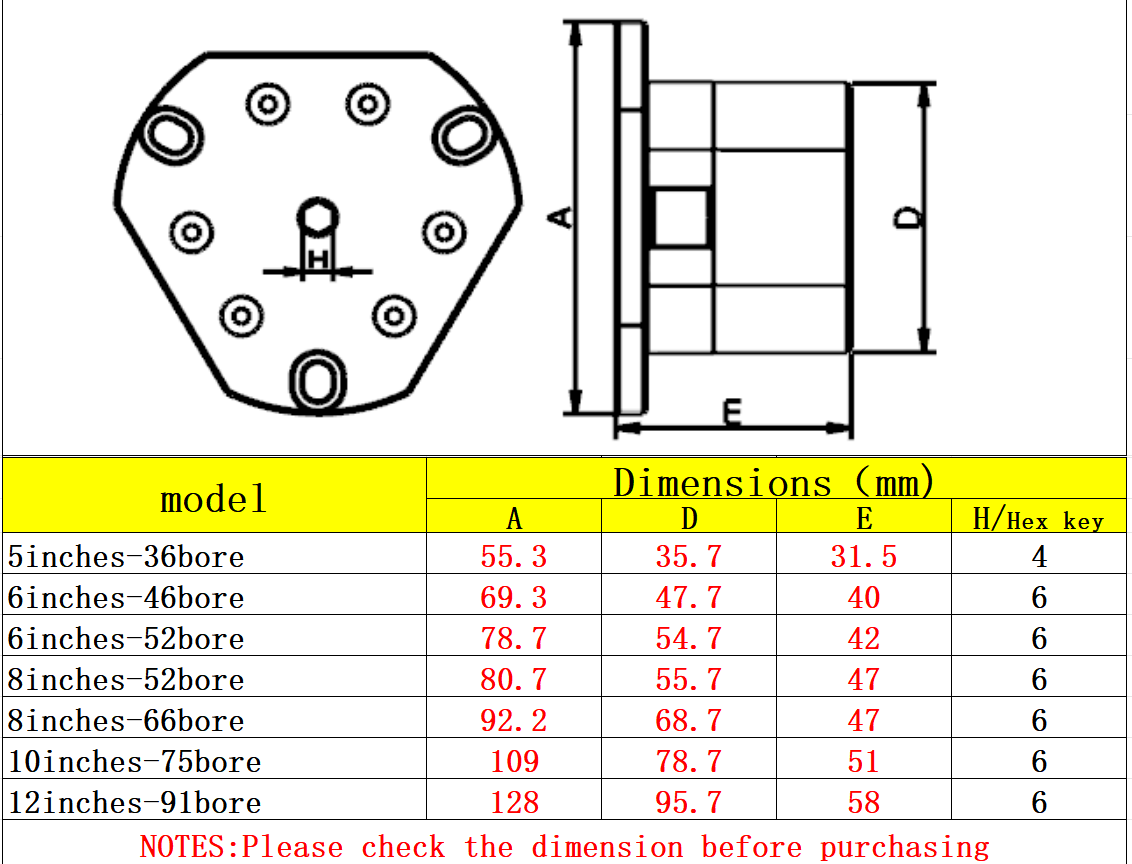
Hydraulic chucks are usually equipped with hard jaws and soft jaws.
■ Hard jaws: Generally, hard jaws are used on lathes for turning bar stock, blanks, etc. They are firmly clamped. The hard jaws are those that have undergone heat treatment and have a Rockwell hardness of over 48. Hard jaws are relatively durable, so they are generally used for rough machining.
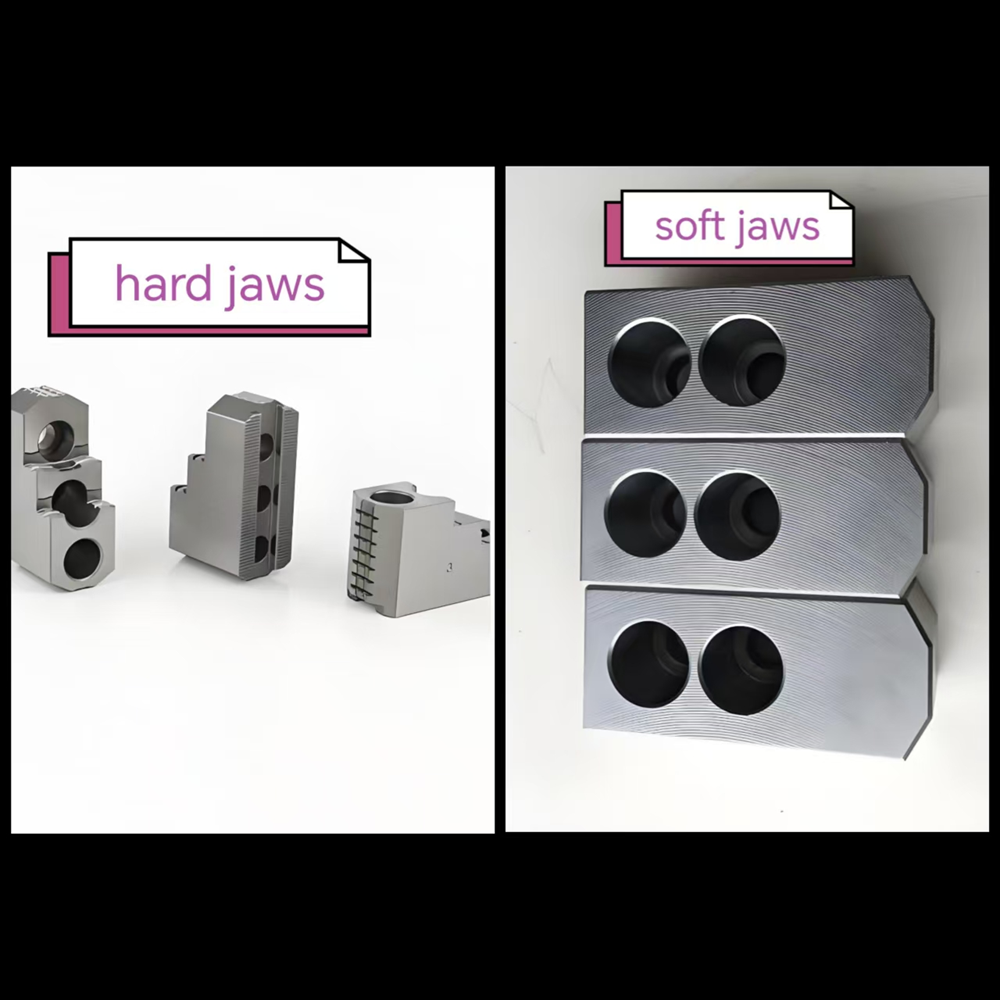
■ Soft jaws: Soft jaws are those that have not undergone heat treatment and are relatively soft. Its function is to process relatively close arcs at any time according to the size of the product to hold the workpiece. Generally, it is applied to hold precisely turned workpieces and can best maintain the coaxiality requirements of the workpiece. The soft jaw can adhere to the surface of the workpiece to the greatest extent, ensuring the transmission of greater torque while also preventing the workpiece from being pinched. These advantages are incomparable to those of the hard jaw. Therefore, correctly correcting the soft jaw is of great significance for improving the accuracy of the workpiece.
What should be noted when making soft jaws?
● Selection of soft jaw material
Here, "soft" means that the processing performance is good, but it does not necessarily have to be lower in hardness than the workpiece.
For large-scale production, the hardness of soft jaws has a significant impact on the stability of processing. Choosing soft jaw materials with a higher hardness than the workpiece not only extends the service life of the soft jaws but also has a positive effect on the stability of processing
Introduction to the Use of Soft jaws on CNC Lathes
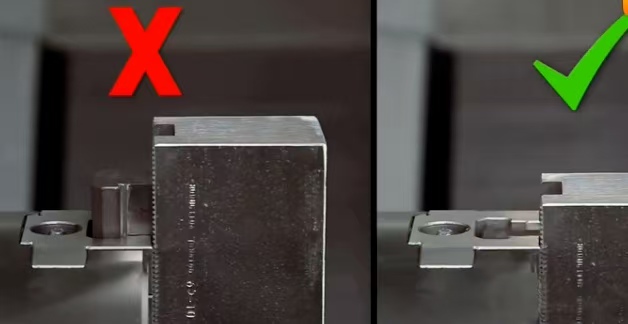
1.Before installation, the iron filings in the soft jaw tooth grooves and the T-shaped grooves of the hydraulic chuck need to be cleaned. Any T-shaped block exceeding the maximum diameter of the chuck is not allowed, as this poses a significant safety risk.
2. Remove the dust cover, check and clean the iron filings embedded in the chuck, and then reinstall the dust cover.
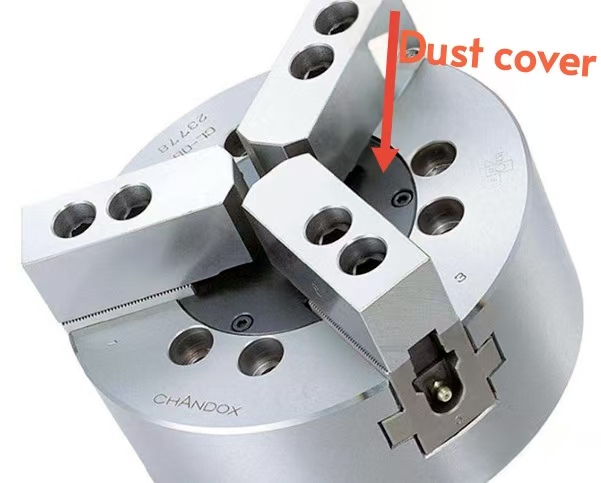
3. Install the three soft jaws in sequence. During installation, be sure that the T-shaped block does not exceed the edge of the chuck. Finally, tighten the fixing screws.
4. Inject an appropriate amount of grease into the lubricating oil injection port of the chuck. It is recommended to use grease with good adhesion. Grease with poor adhesion will be thrown out of the chuck when it rotates at high speed.
5. Install the jaw trimmer on the chuck and adjust its position by repeatedly clamping and releasing the chuck.
6. It is recommended that the pressure during use be close to that during workpiece processing. The chuck should be in the middle of the range of motion during processing, and the direction of the clamping force during jaw trimming should be consistent with that of the workpiece clamping force. Adjust the jaw trimmer to the appropriate position.
7. Pay attention that the chuck pressure during jaw trimming should be close to the pressure of the workpiece being processed, and the direction of the clamping force during jaw trimming should be consistent with the direction of the workpiece clamping. The maximum pressure of the corrector is 10Kg and the maximum rotational speed is 900RPM.
8. To edit the soft jaw processing program, take the required clamping diameter of ø80.0mm, clamping length of 20mm, and the minimum processing diameter of ø40mm as an example to do the following programming.
T0101 M8
G50 S900
G96 M3 S200
G0Z10. 0
G0 X40.0 Z1.0
G71 U1.0 R0.5
G71 P101 Q102 U-0.2W 0.1F 0.15
N101 G0 X80.0
G1 Z0.0 F0.15
G1 Z-20.0F0.1
N102 G1 X39.0 F0.1
G0 X200.0 Z100.0
M5 M9 M30
9. The diameter of the soft jaw should be corrected to be consistent with the clamping diameter; otherwise, three-point contact and six-point contact phenomena will occur.
After the soft jaw processing is completed, root cleaning and tool removal groove processing must be carried out.
When the part of the workpiece that needs to be clamped is relatively long, there will be a situation where the workpiece and the soft jaw cannot be fully attached, commonly known as a "bell mouth". Specifically, it is manifested as a gap left between the top of the soft jaw and the workpiece. At this point, a feeler gauge can be used to check whether the workpiece is fully in contact with the soft jaw after being clamped
12. A taper is machined on the soft jaw, and the size of the gap is measured with a feeler gauge. The length of the clamping is also measured, and then the size of the taper can be calculated.
13. Remove the burrs and sharp corners from the soft jaws. Be extremely careful not to cut your hands.